
Office Renewal or Relocation: What Today’s Office Tenants Should Prioritize

Whether renewing an existing lease or evaluating a relocation, office tenants should focus on
decisions that protect flexibility, control long-term costs, and support how employees actually work
today.
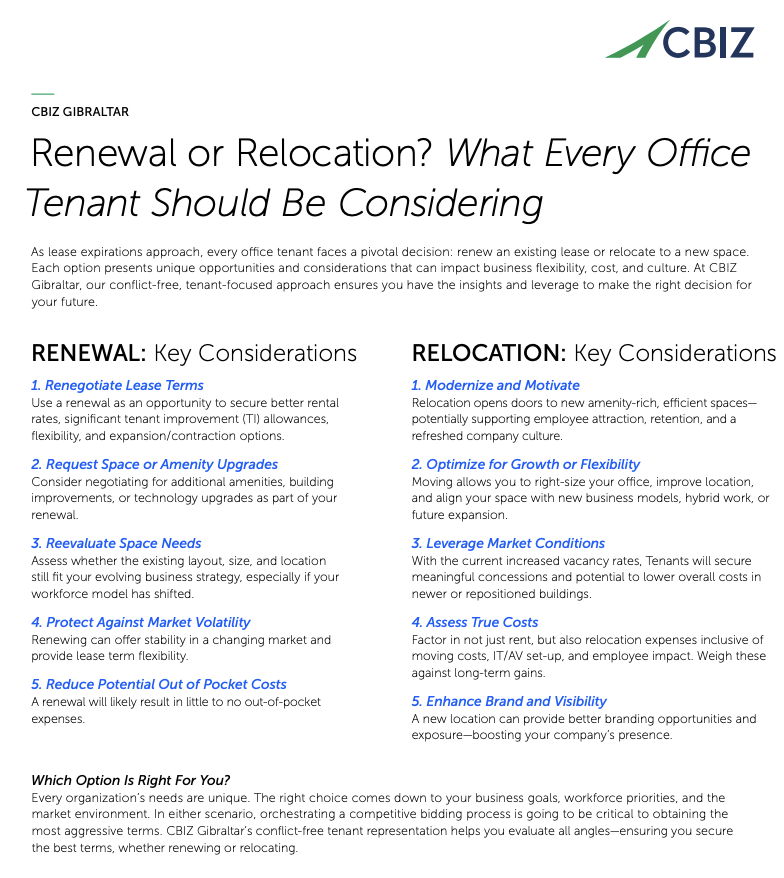
In softer markets — like many office markets across the U.S., including Chicago — tenants who prepare strategically can create significant negotiating leverage, and working with at least 18-24 months allows time to evaluate alternatives, create competition among landlords, and align real estate decisions with business cycles.
A strategic approach for today’s tenants prioritizes control over the outcome, by leveraging best practices across the following steps:
Build Leverage Before Making a Decision
Before deciding whether to stay or move, tenants should understand their negotiating position in the market. That means reviewing current vacancy levels, benchmarking comparable lease transactions, and running a stay-versus-go analysis that evaluates renewal against relocation options. Even tenants expecting to renew often benefit from exploring alternatives. Approaching negotiations with credible options strengthens leverage and typically leads to better outcomes.
Negotiate Flexibility Into the Lease
In uncertain markets, flexibility can deliver more long-term value than simply lowering rent. Tenants should prioritize provisions such as termination options, contraction rights, expansion rights, and practical assignment or sublease language. These protections allow organizations to adapt their footprint if headcount, strategy, or market conditions change. The objective is to ensure the lease can
evolve with the business.
Right-Size for Hybrid Work
Office space decisions should reflect how the workplace functions today. Rather than relying on traditional density models, companies should evaluate real utilization data and design space around collaboration, meeting, and focus areas. In some cases, spec or turnkey suites can also reduce upfront capital requirements. Many organizations are finding that less space with better design performs better than larger, underutilized offices.
Understand the True Cost of Occupancy
Face rent rarely reflects the full financial picture. Operating expenses, escalation structures, parking, security, and after-hours services can significantly influence long-term costs. Two leases with similar rents may produce very different outcomes once these factors are considered. Evaluating total occupancy cost across the lease term helps tenants avoid hidden cost exposure.
Evaluate Building Quality and Ownership
In uncertain markets, both the building and the landlord matter. Tenants should assess ownership
stability, investment in systems and amenities, and the landlord’s track record during past market
cycles. Properties lacking long-term investment may present service or operational risks later. The
goal is to occupy buildings that will remain competitive and well-supported over time.
Choose Locations That Work for Employees
Office attendance is driven largely by convenience and accessibility. Organizations should consider
commuting patterns, transit access, parking, and nearby amenities such as food, fitness, and
services. Submarket preference can also influence employee engagement and utilization.
When location aligns with employee behavior, the workplace becomes far more effective.
Partner With an Independent Tenant Advisor
Many of the best outcomes in lease negotiations come down to representation and strategy. Tenants benefit from advisors who provide full market visibility, objective guidance, and long-term portfolio thinking. Advisors who represent only tenants can ensure recommendations are aligned with the client’s goals rather than landlord inventory. The most successful tenants focus on flexibility, leverage, total cost, and alignment with how their teams actually work.
CBIZ Gibraltar works exclusively on behalf of tenants, helping organizations evaluate renewal and relocation strategies, benchmark market opportunities, and negotiate leases with complete alignment to their business objectives.
For companies evaluating upcoming lease decisions, working with a conflict-free advisor can help
ensure the outcome is not just cheaper—but smarter and lower risk.